Air side

Greyscale backing image
[Dave Birch] The whole business of air travel is a laboratory for experimenting at the boundary between public and private identities, where national and international agreements interact with corporate alliances, outsourcing and value chains to produce a complex environment that needs and benefits from change. Speaking as a frequent traveller, and happy near-weekly user of Heathrow’s Terminal 5, it seems to me that air travel has got considerably quicker, more efficient and simpler in the last couple of years. I print my boarding pass out at home, jump in a cab or on the train, nip through T5 to the lounge and then on to the plane — the only hold-up in the whole process is the queue for security on the way out (sometimes this can be 10-15 minutes even at T5) and the queue for passport control on the way in.

However, the need to print a physical boarding pass, even using 2D barcodes rather than a magnetic stripe, and the lack of an efficient bag drop system means that despite the universal electronic ticket for air travel, more than two-thirds of passengers still went to a check-in desk. Where to look for the next improvement? Well, I’m sure like most people I think that the key technology that will change this is the mobile phone. If the mobile phone allows you to check in and obtain a boarding pass, and a kiosk at the airport allows you to self-tag (clearly there are some security issues around this) then the flow through airports would increase significantly and the costs would reduce accordingly.

In fact I saw a presentation for one of the companies that supplies infrastructure to airports recently an they were talking about their experiences with the mBCBP (mobile bar code boarding pass) — they said that “we only care about Blackberry, iPhone and high-end smartphones”, which means we can assume big, clear screens — but still the current 2D barcode solutions don’t carry enough data for the airlines to store more than three legs plus frequent-flier and other data.

So why am I looking at this space? One of the biggest players in the industry, IER, is advocating the “pass & fly” sticker solution and I saw them present on the Air New Zealand and Air France case studies which, I have to say, was rather impressive.

Close enough for jazz

Greyscale backing image
[Dave Birch] I had a typical fascinating and productive discussion with Hazel Lacohee and Piotr Cofta when we last got together. We were kicking around some ideas for finding practical ways to improve privacy, security and other good stuff while simultaneously worrying about the government's approach to the interweb, broadband and ID cards. With the right combination of technology and vision we can take an entirely different view of the "identity problem" and how to solve it. In a decentralised fashion we can see identity develop as an emergent property of trust networks, shaped by evolution to be fit for purpose or, as Piotr Cofta puts it, "good enough identity". Good enough identity (GEI). I love it.

I'm certain that there is merit in this approach. There is a real difference between between trying to create a kind of "gold standard" identity that delivers the highest possible levels of authentication and identification in all circumstances and trying to create an identity that is useful (defined by: reduces total transaction costs and, in my world, aligns social costs with private costs). Therefore, a utilitarian approach of trying to do something, anything to make the identity situation improve for individuals and organisations, we might be better off starting with some simple building blocks and building up rather than by starting with a national ID card (I mean, a 21st-century national ID card of the psychic ID kind, not electronic cardboard) and driving that down. Go from the personal to the enterprise, from the enterprise to government.

What a cunning stunt

Greyscale backing image
[Dave Birch] I am, very literally, green with envy. I count myself as a reasonably good speaker, and I try to use narrative and historical examples to explain key principles. But nothing beats a good demo, and I saw an excellent one today, one that I wish I’d thought of!

At the Intellect conference on Identity & Information in London today, Edgar Whitely from the LSE gave a terrific presentation. He was pointing out that the principle of data minimisation in identity systems is important, but he did it in a particularly arresting way.

Here’s what he did.

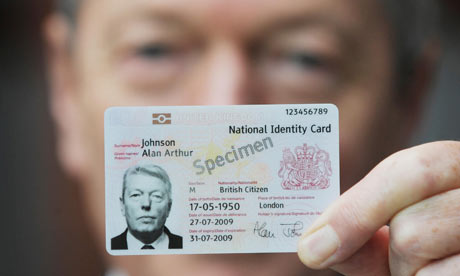
He showed this recent newspaper photograph of the British Home Secretary, Alan Johnson, showing off his new ID card and holding it up to the camera. This version comes from The Guardian

Alan Johnson reveals the design of the British national identity card. Photograph: Stefan Rousseau/PA

As you can see in the picture, for reasons that will be not fully explained in a moment, the UK ID card has the holder’s full name, date of birth and place of birth on it. These three data points are sufficient to uniquely identify the overwhelming majority of the population. So Edgar went to the Identity & Passport Service birth certificate ordering service and put in the details from the Home Secretary’s card. He then paid his £10 and… with a suitably theatrical flourish, Edgar produced the copy of the Home Secretary’s birth certificate that he had been sent in the post. Note that Edgar hadn’t done anything wrong. As James Hall, the head of IPS who was on the same panel, pointed out, in the UK anyone can order a copy of anyone’s birth certificate. He said that if you are a celebrity then hundreds of people will order copies of your birth certificate every year, which had never occurred to me. I’m sure James is right, but it does seem a little odd that people who want to commit identity theft will simply have to look at their mark’s ID card to get started.

Edgar hadn’t used the birth certificate to open a bank account or get a driving licence or anything, he was just making the point that if we don’t adopt the right principles (eg, data minimisation) for identity systems, then we run the risk of making identity theft worse. It was a great presentation and a super stunt. Well done.

Anyone familiar with my deranged rantings about psychic ID (ie, virtually nobody) will be familiar with the general point: a characteristic of a 21st-century ID scheme is that it should only give up information necessary to enable a transactions, nothing more or less. So, if you are authorised to ask my ID card whether I am over 18 or not, that’s all it should tell you. Not my name, not my address, not my age or date of birth. Just whether I am over 18 or not and that’s it.

The current ID card scheme does not have this key characteristic, not for any functional reason but because the ID card and passport were jumbled up for a political purpose — the purpose being, as far as I know, to make it harder for an incoming administration to scrap the scheme — that constrains the design and implementation. Since the government wants the ID card to be used as a travel document within in the EU, it has to have certain human-readable information on it. That’s why it gives away the key data points that make it tempting for criminals to kick-start their identity theft antics.

Balancing security and privacy, part 97

Greyscale backing image
[Dave Birch] I popped along to a City Forum round table on the Information Intensive Society. I was late, because of public transport, so I didn’t hear the chairman say that we were to stick to the Chatham House rule. As a consequence I started twittering what people were saying, as well as posting a picture! I apologise unreservedly — but the medium really is the message, isn’t it? Anyway, the subtitle for the meeting was “balancing security and privacy”, which I think framed the whole discussion the wrong way: the subtitle should have been “obtaining security and privacy”. I don’t want them balanced, I want them both: this is what, to me, marks the difference between these debates in the “old” context and the “new” context.

I think this is why I found the discussion unsatisfying — and I don’t mean this as a criticism of the event, or of the organisers, even though one of the speakers actually did say “the Internet is the future”. The problem is that there is a kind of assumption that privacy is an enemy of security and anyone who advocates more privacy is mutant commie scum (didn’t you used to play Paranoia?). If you put forward any alternative view, then it is answered with the old “well, if you knew what I knew blah blah” and the debate goes nowhere.

The DNS of the industrial bourgeoisie

Greyscale backing image
[Dave Birch] I have a vague memory — which five minutes googling cannot substantiate and I'm too lazy to go and find the book in the other room — that somewhere in the Gulag Archipeligo by Aleksandr Isaevich Solzhenitsyn there is mention of Stalin's desire to have a more revolutionary telephone system where all calls had to go through a central exchange and be encrypted so that Stalin could listen to everyone else's calls but his would be encrypted to remain secret. The prisoners with relevant skills were supposed to be designing this while in the gulag. It never worked, of course, and the Soviet Union had appalling telecommunications infrastructure as a consequence because the communications revolution was halted by the dictatorship of the proletariat: there's some deep incompatibility between innovation and centralisation. I couldn't help thinking of this when I read about the calls by Eugene Kaspersky to have a more Stalinist internet:

The CEO of Russia's No. 1 anti-virus package has said that the internet's biggest security vulnerability is anonymity, calling for mandatory internet passports that would work much like driver licenses do in the offline world.

[From Security boss calls for end to net anonymity • The Register]

What he means by this is that he wants a technologically complicated and expensive solution to be implemented so that ordinary people are inconvenienced to the maximum while criminals can roam free (which is what would happen). Creating such an asymmetric solution is not the way forwards: for one thing, who would decide what to censor?

A little local controversy involving the Church of Scientology and its critics could lead to curbs on the right to anonymity of anyone using the web.

[From Scientology seeks to squash anonymity • The Register]

We already have experience of this "solution" in the UK. Laws giving a wide variety of bodies the ability to monitor CCTV, the internet, phone calls and everything else which were supposed to save us from international terrorism are used by local councils to stop people from trying to get their children into better schools and to check that people are recycling enough of their rubbish. I'm sorry, but creating a world in which anyone can read anyone else's e-mail, track anyone else's web browsing, see what anyone is reading is not the way stop Russian virus writers from taking over everyone's PCs. We need an identity infrastructure.

What is a “suitable” ID for banking?

Greyscale backing image
[Dave Birch] There was a really interesting letter in The Daily Telegraph "Money" section (2nd October). I can't find it online to link to, so I hope they don't mind me quoting a couple of chunks here. The letter comes from someone who tried to open a bank account with HSBC, but who didn't have a current passport or driving licence.

When I explained this at a branch, it was suggested that I ask the police station for proof of identity. The police officers said they had never heard of such a thing unless I had a criminal record.

[From The Daily Telegraph "Jessica Investigates", 2nd October 2009]

That can't be right: you can only have a bank account at HSBC if you have a criminal record? The disappointed would-be bank account holder went back to their branch to ask for alternatives.

The counter person showed me a list of possible documents, but, as I am not a pensioner, nor in receipt of benefits, the only item on the list she could suggest I try was to get a letter from HMRC. I duly went to the local tax office, where the assistant said she wished banks would stop sending people there… they would not waste public money providing such letters for banks.

[From The Daily Telegraph "Jessica Investigates", 2nd October 2009]

The letter goes on to list the documents that the wannabe-HSBCer had presented, and had had rejected by the bank: an out-of-date passport, a birth certificate, a current payslip from an employer (the local council, for whom the person had worked for more than two decades), a work ID card (complete with microchip), utility bills, statements from another bank, house deeds and a voting card. Any one of these would have got you a job with the bank, but not, it seems, an account. Identity is broken, and the Conservative plan to scrap the national ID card scheme is a bad as the government's plan to keep it. What this country needs is a working national identity infrastructure.

“Identity” theft and identity theft

Greyscale backing image
[Dave Birch] There’s a fascinating, but slightly creepy, category of issue that makes for a good acid test of proposals for population-scale identity management. How does the “system” recover when an identity really is stolen? If there’s another you out there, if you have an evil doppelganger, if an ex-partner is taking revenge… if there’s someone out there who is pretending to be you (in fact, in virtual terms, is you) then who do you call? And when you call them, what are they going to do? This is a complicated issue. How do you establish that you really are you? And once you have established this, what do you do with the compromised virtual identity?

The ten minute version

Greyscale backing image
[Dave Birch] A diversion. I filled in a questionnaire about digital identity (for reasons not germane to this post) so I thought it might be mildly interesting to post my answers and see if they attract any comment.

  • Who are you? (Name, job role and organisation)
  • Dave Birch, Director, Consult Hyperion
  • What does the term ‘digital identity’ mean to you?
  • It's the bridge between virtual identities that exist only inside computers and things in the real world.
  • s your digital identity ‘you’? Why? You may also want to comment on whether your ‘digital identity’ is an individual understanding or composed of group, community and organisational identities?
  • My digital identity isn't me, although it may be created by me. In general use, I imagine that people will have a small number of digital identities, just as they have 3 or 4 credit and debit cards, but each of these may support a large number of virtual identities. These virtual identities will, by and large, embody relationships.
  • What skills and competencies do we need to manage our digital identity?
  • We need to implement the "front end" in familiar ways while hiding the OpenID, PKI and all the rest of it. It should be a simple of matter of "who do you want to be today" and choosing from a menu on your mobile phone screen. I do not believe that the average person has either the competenices or, frankly, the inclination to manage their identities (and privacy) properly, so we (ie, responsible professionals) need to construct and infrastructure that will do it for them.
  • What do you see as the current issue/s of concern surrounding digital identity
  • The tension between the unlimited possibilities of technology and the limited vision of politicians, regulators, designers. Since virtual identities do not behave as mere electronic simulations of "real" identities, but can in fact do far more, we need people with vision who can understand what technology can deliver.
  • What do you see as future issue/s of concern in the area of digital identity?
  • Managing multiple digital identities in ways that make sense, so that there's a narrative around identity and privacy that can underpin future social, commercial and government relationships.
  • Which tools and services do you use to manage your digital identity? For example do you separate personal and professional identities?
  • I do separate personal and professional identities. I have different e-mail addresses, different blogs and now different OpenIDs. Sometimes I even comment on things anonymously. Personally, I think this is a natural way to work — my kids do it implicitly when they IM me, e-mail their grandma and Facebook their friends.

i expect my responses were a little different from most people, partly because I spend a lot of time thinking about this sort of thing but also partly because I have quite a strong model of the relationship between real and virtual identities and I locate digital identity there.

Who says?

Greyscale backing image
[Dave Birch] According to a letter I saw a while ago in The Daily Telegraph, British supermarkets won’t accept a British armed forces ID cards as a proof of age, but they will accept foreign ID cards that they cannot read. Or not. It depends what for.

The student’s French ID card was not deemed to be sufficient proof of her age for the staff at Sainsbury’s, even though the chain does accpet the card from foreign workers who wish to work in the UK.

[From Sainsbury’s denies French student]

So you can use your foreign ID card to get a job at Sainsbury’s but not to buy a bottle of champagne. Bizarre, but predictable: this is what happens when we jumble up credentials and identification, absent any well-formed rules for understanding or verifying them. It reminded me of the discussion from a few weeks back concerning the distinction between actual security and security theatre. Here’s a simple example: you go to open bank account and the bank asks to see identity, so you show them a passport. If it is a British passport, they can phone a Home Office hotline to see if it is real, whether it has been reported stolen and so forth. If it is, say, a Bulgarian passport, they cannot possibly tell whether it is real or not, so they just photocopy it and file the copy away somewhere, just as the British Attorney General should have done with her maid’s work permit (since it is an offence is to not to keep a copy of such documentation). Thus, if you are a criminal then you will always choose to use a Bulgarian passport. Honest citizens are inconvenienced, criminals aren’t. This isn’t so much security theatre as security pantomime, as the BBC have highlighted.

The banks are worried it is still too easy to use a counterfeit passport from abroad to open a bank account, or to get an overdraft or credit card.

[From BBC NEWS | Business | Fake passports prompt fraud fear]

Well, I suppose they could always not open the account unless they can understand and verify the identification documents. The fact is, it’s really, really hard for anyone to understand foreign credentials of any kind. Remember the amusing story of the mystery Polish serial traffic offender being tracked by the Irish police?

It was discovered that the man every member of the Irish police’s rank and file had been looking for – a Mr Prawo Jazdy – wasn’t exactly the sort of prized villain whose apprehension leads to an officer winning an award… Prawo Jazdy is actually the Polish for driving licence and not the first and surname on the licence.

[From BBC NEWS | Northern Ireland | The mystery of Ireland’s worst driver]

This does nicely illustrate a key advantage of digital identity over physical identity: this would never happen. If my reader can’t understand your card, that’s the end of the discussion. There’s a nice binary outcome. Where the results depend on human interpretation of shades of grey, surely the system will always throw up crazy outcomes.

An innocent South Tyneside man was arrested because his MoT certificate was a paler shade of green. Michael Cook, from South Shields, had gone to the Driver and Vehicle Licensing Agency (DVLA) centre in Newcastle to renew his car tax. Staff thought his two-week-old MOT certificate was a forgery because it was a lighter shade than his previous one, and the police were called.

[From BBC NEWS | England | Tyne | Arrest over wrong colour MoT form]

Essential to a functional identity system, then, is a cheap and simple “box” for checking whether the card is valid. You put your French ID card, British Forces ID card or Tesco Clubcard into the box at the checkout and the light goes green or red. That’s it.

Innovation that matters for the majority

Greyscale backing image
[Dave Birch] That there is an interplay between the technology and monetary policy is obvious. Look what is going on in Africa. People who aren’t allowed to hold dollar bank account hold dollar-denominated mobile top-up vouchers instead. Ugandans without an effective electronic payment system are using M-PESA from Kenya to execute local transactions in Kenyan shillings. Congolese without access to any banking network use mobile money instead (and may never, ever, want or need a bank account as a result). In India and elsewhere the banks have managed put a regulatory finger in the dyke but the pressure is building and money is already leaking away from conventional institutions and networks into newer, mobile-centric, customer-facing organisations. The dam will, at some point, burst. How will governments be able to “manage” the money supply when it is being zipped across borders by mobile phones, global handset hyper-hawala.

At the very first Digital Money Forum, the late Professor Glyn Davies (author of the magnificent “A History of Money“) said that every technology revolution in money led to less centralised control. That’s a good thing, but it also explains why the conservative nature of governments and regulators comes to the fore in questions concerning money. If anyone anywhere in the world can transact in any currency, then the weak will go to the wall very, very quickly. Gresham’s Law on a global scale.

Subscribe to our newsletter

You have successfully subscribed to the newsletter

There was an error while trying to send your request. Please try again.

By accepting the Terms, you consent to Consult Hyperion communicating with you regarding our events, reports and services through our regular newsletter. You can unsubscribe anytime through our newsletters or by emailing us.